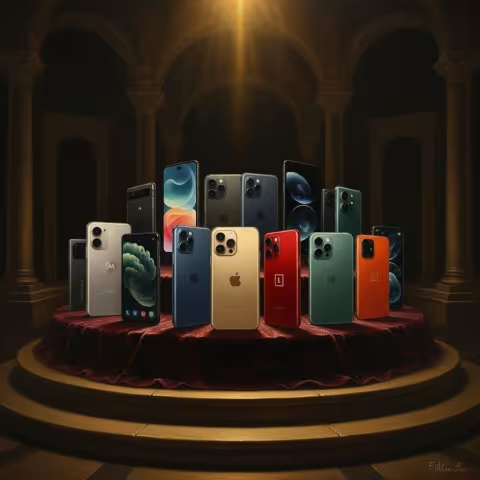
📱 The Silicon in Your Pocket: A Look at the Top 15 Smartphone Brands in the World (2026)
Pick up your phone right now. Look at it. That slab of glass, metal, and silicon in your hand represents decades of fierce competition, failed experiments, and billion-dollar gambles. The smartphone industry is one of the most cutthroat markets in the world — brands rise from obscurity to global dominance in a few years, while once-untouchable giants fade into history.
Think of it like a high-stakes poker table where the chips are billions of dollars and the cards are supply chains, camera sensors, and processor designs. Some players have been at the table for decades, others are newcomers who've won big with bold bets. In this article, we break down the top 15 smartphone brands in the world as of 2026 — covering who founded them, what makes them tick, their biggest breakthroughs, and the pros and cons of each.
1. Samsung
Country: South Korea | Founded: 1969 (as Samsung Electronics) | Founder: Lee Byung-chul | HQ: Suwon, South Korea
History: Samsung started as a trading company in 1938, but Samsung Electronics was born in 1969 making black-and-white TVs. It entered the mobile phone market in the late 1980s, but its true rise began in 2010 with the Galaxy S series — the smartphone lineup that would make Samsung the world's largest phone maker. Today, Samsung is the #1 smartphone manufacturer by volume, shipping hundreds of millions of devices annually.
Key Tech Breakthroughs: Samsung was the first to popularize large AMOLED displays on phones (2010 Galaxy S), pioneered curved-edge screens (Galaxy Note Edge, 2014), introduced the first foldable phone mainstream (Galaxy Z Fold, 2019), and developed its own Exynos processors and ISOCELL camera sensors. It also leads in One UI software customization.
Competitive Edge: Vertical integration — Samsung makes its own displays, memory chips, batteries, and processors. No other phone maker controls as much of its supply chain. Combined with a massive R&D budget (~$20B/year), this lets Samsung iterate faster and control costs better than anyone.
Pros: ✅ Best-in-class displays; widest product range (from budget to foldable); excellent software update policy (7 years); huge ecosystem (watches, buds, tablets); global availability.
Cons: ❌ One UI can feel bloated; Bixby assistant is underwhelming; Exynos processors in some regions lag behind Snapdragon; premium flagships are very expensive.
2. Apple (iPhone)
Country: USA | Founded: 1976 (first iPhone: 2007) | Founder: Steve Jobs, Steve Wozniak, Ronald Wayne | HQ: Cupertino, California
History: Apple didn't invent the smartphone, but it reinvented what a phone could be. When Steve Jobs unveiled the original iPhone in January 2007, it had no physical keyboard, no stylus, and ran a full desktop-class operating system. It was a bet that touchscreens could replace buttons — and that bet changed the world. Today, Apple is the most valuable company on Earth, with iPhones accounting for roughly half its revenue.
Key Tech Breakthroughs: Multi-touch capacitive touchscreen (2007), the App Store (2008) creating the mobile app economy, Retina Display (2010), Touch ID (2013), Face ID (2017), the M-series chips for iPad/iPhone performance dominance, and the transition to USB-C (2023). Apple's A-series and M-series chips are consistently the fastest mobile processors on the market.
Competitive Edge: Ecosystem lock-in. Once you're in the Apple ecosystem (iPhone + AirPods + Apple Watch + Mac + iCloud), leaving becomes hard. The seamless integration between devices, best-in-class app store curation, privacy-first marketing, and unmatched customer loyalty create a moat competitors can't cross.
Pros: ✅ Best performance (A/M-series chips); excellent camera processing; 7+ years of software updates; unmatched ecosystem integration; strong privacy focus; high resale value.
Cons: ❌ Very expensive; Lightning/USB-C transition was late; limited customization; closed ecosystem (no sideloading in most regions); slow to adopt some features (120Hz display, foldables).
3. Xiaomi
Country: China | Founded: 2010 | Founder: Lei Jun | HQ: Beijing, China
History: Xiaomi burst onto the scene in 2011 with the Mi 1 — a flagship-tier phone sold at budget prices through an online-only flash sale model. It was like breaking into a luxury hotel through the service entrance: you get the same amenities, but pay a fraction of the price. Within a decade, Xiaomi became the #3 smartphone brand globally and the youngest company on the Fortune Global 500.
Key Tech Breakthroughs: Xiaomi popularized the "flagship killer" concept — high-end specs at mid-range prices. It pioneered under-display camera technology (Mi Mix, 2016), 120W wired charging (2021), 200MP camera sensors, and the HyperOS ecosystem connecting phones, cars, and smart home devices.
Competitive Edge: Aggressive pricing combined with huge scale. Xiaomi runs on razor-thin margins on hardware (often below 5%) and makes money from services and its massive IoT ecosystem. Its AIoT (AI + IoT) platform has over 750 million connected devices.
Pros: ✅ Incredible value for money; feature-packed MIUI/HyperOS; massive smart home ecosystem; fast charging technology; wide product range from budget to premium.
Cons: ❌ HyperOS has bloatware ads in some markets; software update policy is shorter than Samsung/Apple; camera processing lags behind Apple and Google; limited availability in Western markets.
4. Oppo
Country: China | Founded: 2004 | Founder: Tony Chen (Chen Mingyong) | HQ: Shenzhen, China
History: Oppo started as a consumer electronics company making MP3 players and DVD players before pivoting to smartphones in 2008. It's part of the BBK Electronics conglomerate (along with Vivo, Realme, and OnePlus). Oppo is known for its strong presence in Asia and aggressive camera innovation.
Key Tech Breakthroughs: Oppo pioneered the pop-up selfie camera (Find X, 2018) for a true full-screen display, introduced 125W SuperVOOC charging (one of the fastest charging standards in the world), and developed the MariSilicon X imaging NPU for superior camera processing.
Competitive Edge: Camera technology leadership and fast charging. Oppo's SuperVOOC charging can fully charge a phone in under 20 minutes. Its partnership with Hasselblad for camera tuning also gives it a photography edge in the premium segment.
Pros: ✅ Best-in-class fast charging; innovative camera hardware; excellent build quality; strong presence in Asia; ColorOS is clean and feature-rich.
Cons: ❌ Limited Western market presence; software update policy inconsistent; premium Find series is expensive; brand perception is weaker than Samsung/Apple.
5. Vivo
Country: China | Founded: 2009 | Founder: Shen Wei | HQ: Dongguan, China
History: Vivo, another BBK Electronics brand, launched in 2009 and rapidly grew in China and India. It's known for pushing the boundaries of smartphone photography and audio innovation, often being the first to commercialize technology that competitors are still prototyping.
Key Tech Breakthroughs: Vivo introduced the first in-display fingerprint sensor in a mass-market phone (X20 Plus UD, 2018), the first phone with a gimbal-style camera stabilization system (X50 Pro, 2020), and the first phone with a 200MP sensor and Zeiss optics (X90 Pro+). It also developed the V-series imaging chips for dedicated camera processing.
Competitive Edge: Camera innovation partnerships with Zeiss, and a focus on premium audio hardware (Hi-Fi DACs in many models). Vivo's OriginOS in China and Funtouch OS globally offer unique customization.
Pros: ✅ Pioneering in-display fingerprint tech; excellent camera hardware with Zeiss tuning; gimbal stabilization is unique; strong audio quality; good build quality.
Cons: ❌ Funtouch OS can be inconsistent; limited Western availability; slower software updates; brand not well known outside Asia.
6. Huawei
Country: China | Founded: 1987 | Founder: Ren Zhengfei | HQ: Shenzhen, China
History: Huawei started as a telecom equipment provider before entering consumer phones in the early 2010s. By 2019, it had surpassed Apple to become the world's #2 smartphone brand. Then the US trade ban hit — cutting off Google services, chip supply, and critical components. Like a boxer who got hit with a low blow but refused to go down, Huawei pivoted hard, developing its own HarmonyOS and Kirin chipsets, surviving but at reduced scale.
Key Tech Breakthroughs: Huawei pioneered Leica-branded camera phones (P9, 2016), introduced the first phone with a 5x optical periscope zoom (P30 Pro, 2019), developed its own Kirin processors (rivaling Snapdragon), and built HarmonyOS as a full Android alternative after the US ban.
Competitive Edge: Telecommunications infrastructure expertise gives Huawei unique advantages in 5G and connectivity. Its camera technology remains among the best in the world, and its in-house chip design (Kirin + Ascend NPUs) is world-class.
Pros: ✅ Exceptional camera hardware; excellent build quality; strong 5G/RF engineering; own Kirin chips are competitive; Mate and P series are iconic.
Cons: ❌ No Google Play Services outside China; US trade restrictions limit global availability; HarmonyOS has fewer apps than Android/iOS; brand trust issues in Western markets.
7. Motorola (Lenovo)
Country: USA (owned by Lenovo/China) | Founded: 1928 (Motorola), 2011 (Motorola Mobility) | Founder: Paul Galvin | HQ: Chicago, Illinois
History: Motorola literally invented the mobile phone — the DynaTAC 8000X in 1983 was the first commercially available cell phone. The Razr flip phone (2004) was the best-selling clamshell phone ever. After being acquired by Google in 2011 and then Lenovo in 2014, Motorola reinvented itself as a mid-range Android champion with near-stock software and competitive pricing.
Key Tech Breakthroughs: First commercial mobile phone (DynaTAC, 1983), iconic Razr flip phone (2004), first phone with Android (Motorola Droid, 2009), Moto Mods modular accessories (2016), and the modern Razr foldable (2019) reviving the flip-phone form factor.
Competitive Edge: Near-stock Android experience (clean, bloatware-free), fast updates for its price range, and a strong lineup of budget and mid-range phones. The Razr foldable offers a unique alternative to Samsung's Galaxy Z Flip.
Pros: ✅ Clean Android experience; good value for mid-range phones; iconic brand heritage; innovative foldable Razr; useful Moto Actions (chop for flashlight).
Cons: ❌ Camera performance lags behind competitors; premium segment is weak; Lenovo ownership creates brand confusion; slower updates on budget models.
8. Realme
Country: China | Founded: 2018 | Founder: Sky Li (Li Bingzhong) | HQ: Shenzhen, China
History: Realme is the youngest brand on this list — and also the fastest-growing. It started as an Oppo sub-brand in 2018, targeting budget-conscious youth in India and Southeast Asia. Within three years, it became one of the top smartphone brands in India. It's like a startup that learned from its parent's 15 years of experience and sprinted out of the gate.
Key Tech Breakthroughs: Realme popularized 5G in budget phones earlier than most competitors, introduced 150W ultra-fast charging in mid-range devices, and was one of the first to bring 64MP and 108MP cameras to affordable phones.
Competitive Edge: Aggressive specs-to-price ratio — Realme often undercuts Xiaomi on price while offering similar or better hardware. Fast charging leadership and a youthful, design-focused brand image.
Pros: ✅ Incredible value for budget buyers; fast charging leadership; youthful design; strong performance in India and Southeast Asia; innovative GT series.
Cons: ❌ Realme UI has bloatware; limited presence in Western markets; software update policy is short; build quality inconsistent across price tiers.
9. OnePlus
Country: China | Founded: 2013 | Founder: Pete Lau, Carl Pei | HQ: Shenzhen, China
History: OnePlus started with a single mission: build a flagship phone with flagship specs at a price that made competitors look greedy. The OnePlus One (2014) — "the flagship killer" — required an invite to buy, creating artificial scarcity and a cult following that most brands can only dream of. The community-driven approach, active forums, and developer-friendly software made OnePlus the enthusiast's choice.
Key Tech Breakthroughs: Introduced 90Hz and 120Hz displays to mainstream Android flagships (OnePlus 7 Pro, 2019), pioneered 65W Warp Charging, and co-developed the OxygenOS software — widely considered the best Android skin for its speed and cleanliness.
Competitive Edge: Once known for flagship-killer pricing, OnePlus has shifted upmarket. Its phones still offer excellent performance (Snapdragon flagship chips), fast charging, and clean software. The merger with Oppo in 2021 unified R&D and supply chain.
Pros: ✅ Excellent display quality; fast, clean OxygenOS (now ColorOS-based); very fast charging; strong community; great performance for the price (historically).
Cons: ❌ No longer a "flagship killer" — prices rival Samsung/Apple; OxygenOS lost its unique identity after Oppo merger; cameras are good but not best-in-class; limited availability in some markets.
10. Honor
Country: China | Founded: 2013 (spun off from Huawei: 2020) | Founder: Originally a Huawei sub-brand | HQ: Shenzhen, China
History: Honor started in 2013 as Huawei's answer to Xiaomi — online-only, budget-friendly phones aimed at young buyers. Then came the US trade ban on Huawei. To survive, Huawei sold Honor in November 2020 to a consortium of buyers. Since going independent, Honor has rebuilt itself from scratch, regaining access to Google services, Snapdragon chips, and global markets.
Key Tech Breakthroughs: Honor brought flagship-tier OLED displays and camera systems to mid-range prices. Its Magic series competes directly with Huawei's Mate/P series, and its foldable Magic V series rivals Samsung's Galaxy Z Fold in build quality.
Competitive Edge: Access to both Huawei's engineering talent (many ex-Huawei engineers) and global supply chains (Snapdragon, Google). Strong camera R&D inherited from Huawei, combined with aggressive pricing in Europe and Asia.
Pros: ✅ Strong camera hardware inherited from Huawei; good build quality; access to Google Services; aggressive pricing; fast-growing in Europe.
Cons: ❌ Brand awareness is still rebuilding; software (MagicOS) needs refinement; limited availability in the US; after-sales service varies by region.
11. Google Pixel
Country: USA | Founded: 2016 | Founder: Google | HQ: Mountain View, California
History: Google launched the Pixel brand in 2016 as the successor to the Nexus line. While Nexus phones were developer-focused budget devices, Pixel was Google's premium vision of what Android should be. Think of it as Google building the car and the road at the same time — controlling both the hardware and the software to create a seamless experience no other Android OEM can match.
Key Tech Breakthroughs: Google pioneered computational photography with the Pixel's HDR+ and Night Sight modes — using AI to produce stunning photos from a single lens while competitors needed three or four. It introduced Call Screen (AI answering calls), Magic Eraser (remove objects from photos), and is the first to get new Android updates. The Tensor chips (Google's own silicon) now power Pixel-exclusive AI features.
Competitive Edge: Pure Google experience — first to get Android updates, no bloatware, exclusive AI features (Call Screen, Hold for Me, Magic Editor). The Pixel camera, despite using "older" hardware, consistently produces some of the best photos due to Google's computational photography.
Pros: ✅ Best Android camera through software processing; clean stock Android; first to receive updates (7 years); exclusive AI features; Tensor chip enables unique capabilities.
Cons: ❌ Hardware lags behind competitors (slower charging, older displays); Tensor chips are less powerful than Snapdragon; limited availability in many countries; battery life is average; no foldable (yet) until Pixel Fold.
12. Sony (Xperia)
Country: Japan | Founded: 2001 (as Sony Ericsson), 2012 (Sony Mobile) | Founder: Joint venture (Sony + Ericsson) | HQ: Tokyo, Japan
History: Sony Ericsson was a joint venture that produced iconic phones like the Walkman music phones and the Cyber-shot camera phones. After Sony bought out Ericsson in 2012, the brand became Sony Mobile, focusing on premium Xperia devices. Sony phones are like a high-end camera that also happens to make calls — the camera hardware is extraordinary, but the phone is designed for enthusiasts who value photography above all else.
Key Tech Breakthroughs: Sony supplies camera sensors to almost every other smartphone maker (including Apple and Samsung), but saves its best technology for its own phones. The Xperia 1 series features 4K HDR OLED displays, real-time eye-tracking autofocus from Sony's Alpha camera line, and dedicated shutter buttons with manual camera controls.
Competitive Edge: Sony's camera expertise is unmatched — it makes the sensors that go into iPhones and Galaxys, and its own phones offer professional-grade photography and videography tools. The 4K display and headphone jack are rare premium features.
Pros: ✅ Industry-leading camera sensors; 4K HDR OLED display; headphone jack on flagship models; pro-grade camera software; excellent build quality.
Cons: ❌ Very expensive for the hardware spec; outdated design language; poor software update track record; small market share means limited accessories; Sony's phone division is chronically undersized.
13. Tecno
Country: Hong Kong (China) | Founded: 2006 | Founder: Transsion Holdings | HQ: Hong Kong
History: Tecno is the king of the African smartphone market, a position most people in the West have never heard of. While Samsung and Apple fight over North America and Europe, Tecno quietly built a empire across Africa, the Middle East, South Asia, and Latin America. Its parent company, Transsion Holdings, also owns Infinix and Itel, making Transsion the largest smartphone seller in Africa overall.
Key Tech Breakthroughs: Tecno pioneered features tailored for African markets — skin tone-optimized camera algorithms (AI Beauty mode for darker skin), ultra-low-light photography for dimly lit environments, massive batteries (5,000-7,000 mAh) for areas with unreliable power, and multi-SIM support (up to 4 SIM cards) for users who carry multiple networks.
Competitive Edge: Deep understanding of emerging market needs. Tecno's phones are built specifically for the challenges of their target markets — unreliable power (big batteries), hot climates (durable builds), and price sensitivity (aggressive pricing). HiOS software is tailored with local language support and services.
Pros: ✅ Dominant in Africa and emerging markets; tailored features for local needs; excellent battery life; very affordable pricing; strong multi-SIM support.
Cons: ❌ Not available in most Western countries; HiOS has bloatware; average camera performance (except skin-tone tuning); build quality is budget-tier; limited premium offerings.
14. Asus (ROG Phone & Zenfone)
Country: Taiwan | Founded: 1989 | Founder: Ted Hsu, T.H. Tung, Wayne Hsieh, M.T. Liao | HQ: Taipei, Taiwan
History: Asus is best known as a PC and motherboard manufacturer, but it's made smartphones since 2014. Its phone division serves two very different audiences. The ROG Phone series is like a Formula 1 car built for mobile gaming — absurd cooling systems, 165Hz AMOLED displays, shoulder trigger buttons, and clip-on fan accessories. The Zenfone series, meanwhile, focuses on compact flagship phones (a rarity in 2026) with clean software.
Key Tech Breakthroughs: ROG Phone pioneered mobile gaming phones with active cooling (internal fan), AirTrigger ultrasonic shoulder buttons, and 165Hz displays. Zenfone kept the compact flagship dream alive with phones that fit in one hand while packing flagship processors.
Competitive Edge: Two unique niches — mobile gaming (ROG Phone has no real competitor except RedMagic) and compact flagships (Zenfone is one of the few small-screen premium phones left). Asus's PC cooling expertise translates directly to phone thermal management.
Pros: ✅ Best mobile gaming phone (ROG); excellent cooling and performance; unique compact flagship (Zenfone); clean ZenUI software; headphone jack on both lines.
Cons: ❌ Very niche appeal; camera performance is average; limited availability; battery life on compact Zenfone is mediocre; ROG Phone is thick and heavy.
15. Nokia (HMD Global)
Country: Finland | Founded: 1865 (original Nokia), 2016 (HMD Global) | Founder: Fredrik Idestam (original) | HQ: Espoo, Finland
History: Nokia was once the undisputed king of mobile phones — at its peak in 2007, it held over 50% of the global market share. Then came the iPhone. Nokia famously failed to adapt, and by 2013, its phone business was sold to Microsoft. In 2016, HMD Global licensed the Nokia brand and brought it back as an Android phone maker. Today's Nokia is like a retired champion who came back to coach amateur leagues — no longer at the top, but still respected and focused on doing the basics right.
Key Tech Breakthroughs: Nokia's historical breakthroughs are legendary — the first commercial GSM phone (Nokia 1011, 1992), the iconic Nokia 3310 (2000), the first camera phone (Nokia 7650, 2002), and the first pure Android One program phone (Nokia 6, 2017). Today, HMD focuses on Android One (clean, secure, and updated) and durability.
Competitive Edge: Android One promise — clean, bloat-free Android with guaranteed security updates for 3 years and OS upgrades for 2. Nokia still has strong brand recognition in emerging markets and is known for durable, reliable devices.
Pros: ✅ Clean Android One experience; reliable security updates; durable build quality; good brand trust in emerging markets; affordable pricing.
Cons: ❌ No true flagship devices; camera performance is below average; slow to adopt new technology; very small market share outside developing countries; limited premium offerings.
Quick Comparison by Category
🏆 Best Overall: Samsung — unmatched variety from budget to foldable
🍏 Best Premium Experience: Apple — if it's in the budget, the ecosystem is unbeatable
💵 Best Value for Money: Xiaomi — flagship specs at mid-range prices
📸 Best Camera: Google Pixel (software) / Huawei (hardware) — pick your poison
🔋 Best Battery & Charging: Oppo / Realme — 100W+ charging changes the game
🎮 Best for Gaming: Asus ROG Phone — active cooling, shoulder triggers, 165Hz display
🌍 Best for Emerging Markets: Tecno / Infinix — built specifically for local conditions
📱 Best Compact Flagship: Asus Zenfone — one of the last small premium phones
🔄 Best Software Experience (Android): Google Pixel — pure Android, first updates
🇪🇺 Best Growing Brand in Europe: Honor — rebuilding fast with Huawei DNA
🔮 Bottom Line
The smartphone market in 2026 is a tale of three worlds:
- 🌐 The Premium World (Apple + Samsung): These two account for the majority of industry profits. Apple takes ~85% of all smartphone profits despite selling fewer units. Samsung dominates volume.
- 🌏 The Chinese Powerhouses (Xiaomi, Oppo, Vivo, Realme, Honor): These brands have perfected the art of delivering 90% of a flagship experience for 60% of the price. They dominate Asia and are growing fast in Europe and Latin America.
- 🌍 The Niche Players (Google, Sony, Asus, Nokia) & Emerging Market Kings (Tecno): These brands survive by serving specific audiences — Pixel for Android purists, Sony for camera enthusiasts, Asus for gamers, Tecno for Africa and South Asia.
The most important trend? Chinese brands now make up over half of the top 15. The center of gravity for smartphone innovation shift between Silicon Valley and Shenzhen. Developing world smartphone users prefer buying a Xiaomi, Oppo, or Tecno. The winners are the ones who understand that a smartphone isn't just a piece of hardware — it's a window into how different parts of the world live, work, and connect.